
3/5/26
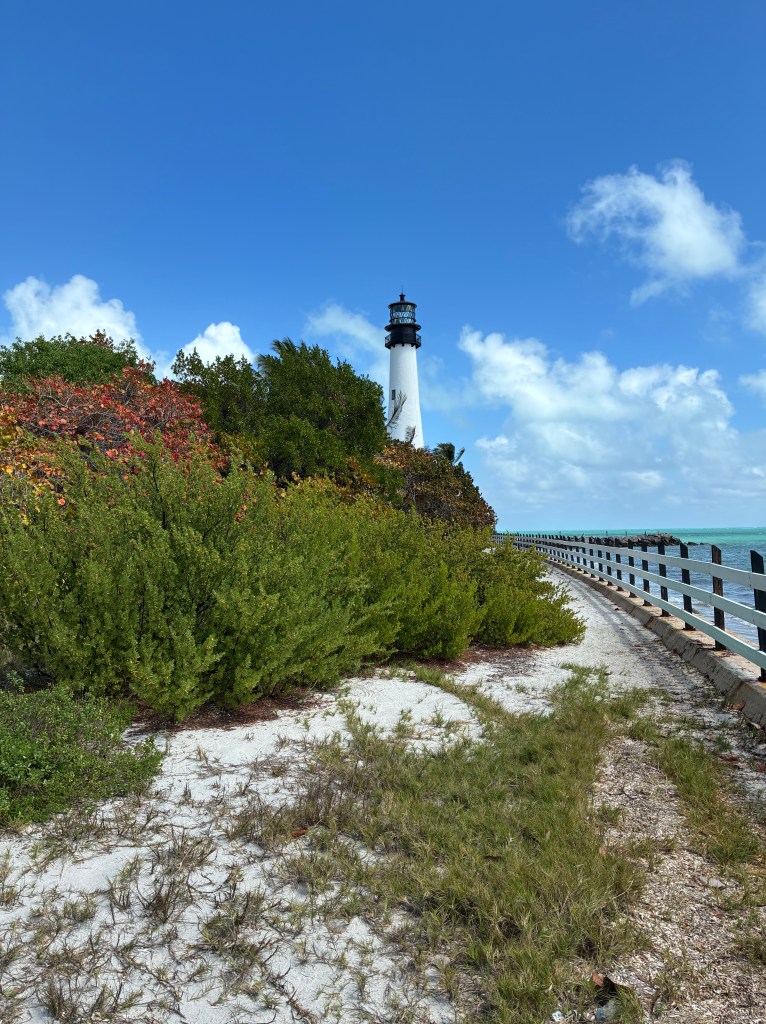
Today I helped drive 63 miles to South Miami. Tomorrow I’ll start my three day trek west across the Florida Keys. We arrive early at church and decide to travel east by car about 5 miles to the Key Biscayne State Park. There I see a lighthouse that was created in the early 1820s and has since been reconstructed after having been destroyed first by the Seminole Indians in a revolt and then after the South surrendered the Civil War.
The keys have been habited for nearly 1000 years by local native Americans. The Seminoles were moved to Mississippi much against their will. There are archaeological digs near the lighthouse dating back to about 1000 AD.
I was curious about the word “key” so I decided to research it and share with you when I learned. Much of this is from Wikipedia.
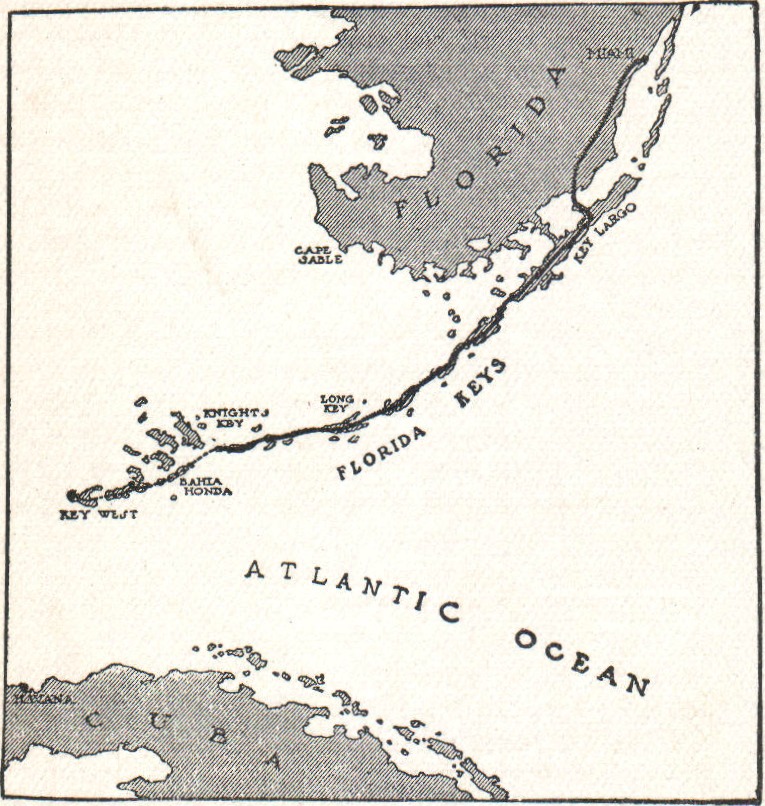
The Keys are a string of islands starting just east of Miami, extending to Key West and beyond ( un inhabited). They are formed on top of ancient coral reefs going back millennia now covered by sand and soil with eventual vegetation and human habitation.
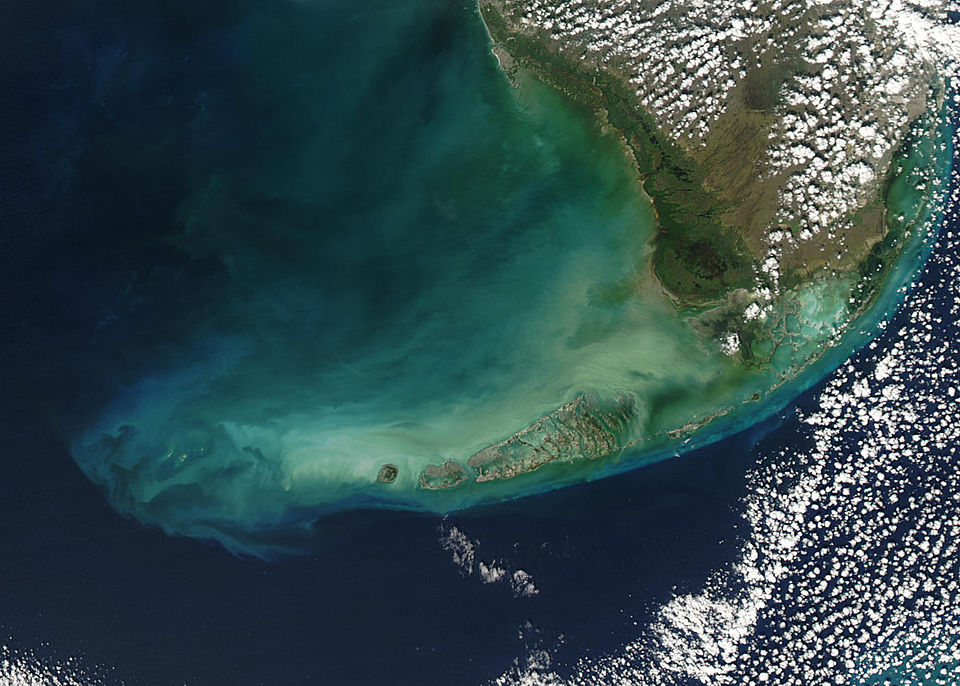
The islands lie along the Florida Straits, dividing the Atlantic Ocean to the east from the Gulf of Mexico to the northwest, and defining one edge of Florida Bay
The Keys were originally inhabited by the Calusa and Tequesta people and were later charted by Juan Ponce de León in 1513. De León named the islands Los Martires (“The Martyrs”), as they looked like suffering men from a distance. “Key” is derived from the Spanish word cayo, meaning small island.

The northern and central sections of the Florida Keys are the exposed portions of an ancient coral reef, the Key Largo Limestone. The northernmost island arising from the ancient reef formation is Elliott Key, in Biscayne National Park. North of Elliott Key are several small transitional keys, composed of sand built up around small areas of exposed ancient reef. Further north, Key Biscayne and places north are barrier islands, built up of sand. The islands in the southwestern part of the chain, from Big Pine Key to the Marquesas Keys, are exposed areas of Miami Limestone.
The Florida Keys have taken their present form as the result of the drastic changes in sea level associated with recent glaciations or ice ages. Beginning some 130,000 years ago the Sangamonian Stage raised sea levels about 25 feet (7.6 m) above the current level. All of southern Florida was covered by a shallow sea. Several parallel lines of reef formed along the edge of the submerged Florida Platform, stretching south and then west from the present Miami area to what is now the Dry Tortugas. This reef formed the Key Largo Limestone that is exposed on the surface from Soldier Key (midway between Key Biscayne and Elliott Key) to the southeast portion of Big Pine Keyand the Newfound Harbor Keys. The types of coral that formed Key Largo Limestone can be identified on the exposed surface of these keys. Minor fluctuations in sea level exposed parts of the reef, subjecting it to erosion. Acidic water, which can result from decaying vegetation, dissolves limestone. Some of the dissolved limestone redeposited as a denser cap rock, which can be seen as outcrops overlying the Key Largo and Miami limestones throughout the Keys. The limestone that eroded from the reef formed oolites in the shallow sea behind the reef, and together with the skeletal remains of bryozoans, formed the Miami Limestone that is the current surface bedrock of the lower Florida peninsula and the lower keys from Big Pine Key to Key West. To the west of Key West the ancient reef is covered by recent calcareous sand. While the islands of the upper and middle keys, consisting of Key Largo Limestone, form a long narrow arc, the islands of the lower keys are perpendicular to the line of that arc. This configuration arose from an ancient tidal-bar system, in which tidal channelscut through a submerged oolitic deposit. The bars lithified into Miami Limestone, and with changes in sea level are presently exposed as the islands, while the channels between the bars now separate the islands.
This is all rather “Greek scientific gibberish” to me but I’m sure some of you readers out there understand it.

 Time Travelling with a Guardian Angel